
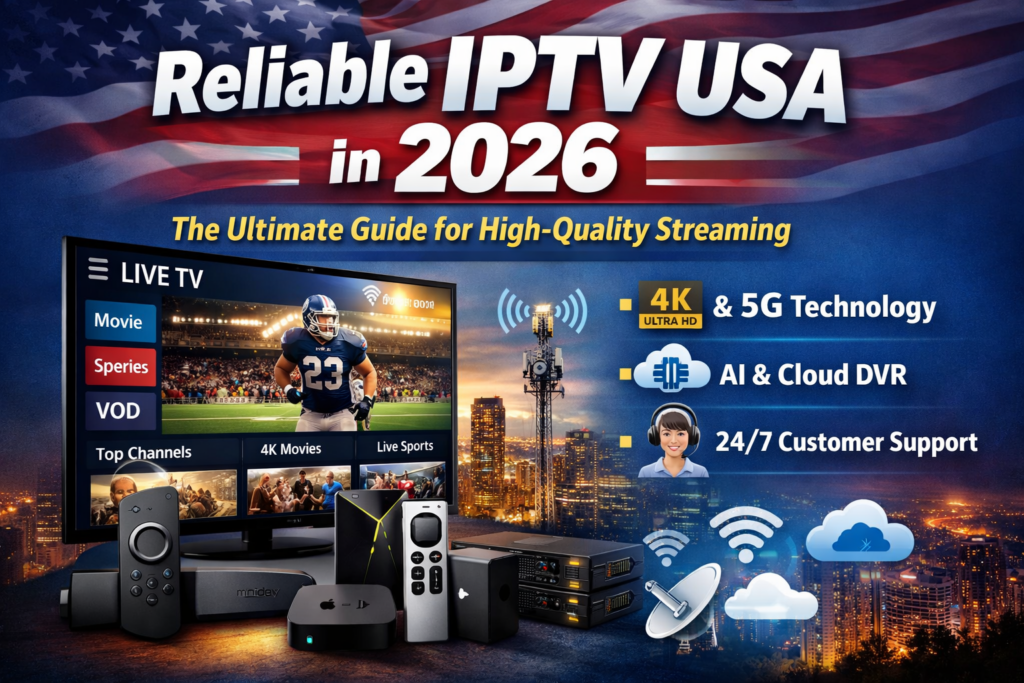
Reliable IPTV USA in 2026 — learn how the U.S. IPTV market evolves with streaming reliability, channel stability, performance, and service innovation.
Understanding the Growth of Reliable IPTV USA in 2026
The IPTV landscape in the United States has transformed fast over the last decade, but 2026 marks a noticeable milestone. As consumers increasingly cut the cable cord, the demand for reliable IPTV USA services surged, largely due to improved broadband speeds, better server infrastructure, and higher expectations from American households.
What Makes IPTV Services More Reliable Today
In 2026, service reliability stems from a combination of:
- high-performance CDNs
- redundant servers
- enhanced anti-freeze protocols
- stronger licensing partnerships
- 5G enablement
- scalable cloud infrastructures
Instead of treating reliability as a luxury feature, IPTV providers in the U.S. now treat it as the baseline.
Key Differentiators Between Reliable & Unstable IPTV Providers
Consumers have learned to spot weak IPTV services quickly. The most notable differentiators include:
| Reliable IPTV Provider Traits | Unstable IPTV Provider Traits |
|---|---|
| Multiple backup servers | Single centralized server |
| 24/7 customer support | Slow or non-existent support |
| Licensed content access | Risky, unlicensed content |
| Stable VOD systems | Missing or outdated VOD |
| Transparent pricing | Hidden fees |
| U.S.-based CDN routes | Overseas tunnel routing |
The increased maturity of the market means Americans expect consistency, not novelty.
2. Why IPTV Reliability Matters for U.S. Consumers
Not long ago, reliability wasn’t a top-tier demand. Viewers prioritized channel count or subscription price. However, in 2026, consumers value reliability because IPTV competes directly with platforms like Netflix, Hulu, and YouTube TV.
Customer Expectations in 2026
American households have shifted their expectations dramatically:
- Zero buffering tolerance
- Instant channel switching
- Multi-device viewing
- UHD streaming quality
- 24/7 uptime
- DVR-like content access
- Real customer service
Consumers don’t just want content; they want consistent uptime.
The Cost of Service Interruptions
Service interruptions cost:
- Providers: churn, reputation damage, refunds, and legal exposure
- Consumers: wasted money, event disruption (like sports), and frustration
The spike in live sports IPTV viewership made reliability even more critical. When millions watch the Super Bowl on IPTV, downtime isn’t an option.
3. Infrastructure Behind Reliable IPTV in the USA
Behind the scenes, reliability is powered by infrastructure investments that ensure stability even during peak loads.
CDN Improvements in 2026
CDNs (Content Delivery Networks) evolved to include:
- Regional edge nodes
- AI-based traffic balancing
- DDoS mitigation tools
- Smart routing optimizers
These innovations help keep latency at bay.
IPv6, Fiber Internet & 5G Role
Reliable IPTV USA performance improved massively thanks to improved national broadband, including:
- Fiber internet adoption surpassing rural limitations
- 5G fixed-wireless access
- IPv6 enabling more efficient data routing
These technologies replaced bottleneck-prone legacy networks that once made IPTV unpredictable.
Server Redundancy Models
Modern IPTV companies deploy:
- Multi-data-center architectures
- Geo-redundant clusters
- Failover DNS systems
- Adaptive load balancing
This redundancy means that if one node fails, traffic jumps instantly to another.
4. Content Delivery Standards & Video Quality Enhancements
Video quality directly influences reliability perception. Americans often judge reliability by visual clarity and playback stability, not just uptime metrics.
4K, HDR, 10-bit & Variable Bitrate Streaming
By 2026, most reliable IPTV USA providers offer:
- 1080p as baseline
- 4K sports & VOD titles
- HDR10 and 10-bit color depth
- Variable bitrate streaming (VBR)
- Low-latency transport for live channels
Viewers now expect cinema-caliber quality from home.
Real-Time Error Correction Protocols
Advanced protocols now auto-correct:
- packet loss
- jitter
- transmission delay
- bitrate instability
This reduces buffering without requiring faster internet speeds.
5. Evaluating IPTV Providers in the U.S. Market
Before choosing a provider, American consumers use evaluation criteria that didn’t exist a few years ago.
Important Metrics for Choosing a Provider
Buyers now consider:
- uptime percentage (≥99.8%)
- resolution formats
- VOD availability
- device compatibility
- server location proximity
- support responsiveness
- pricing transparency
- licensing arrangements
This marks a matured IPTV consumer base.
Red Flags of Unreliable IPTV Services
Consumers also look for warning signs:
- no trial period
- poor channel zapping speed
- unavailable customer support
- outdated UI
- mixed routing paths
- usage via VPN requirement
- missing American sports networks
Red flags indicate instability or legal uncertainty.
6. Legal Considerations With IPTV in the USA
Quality IPTV isn’t only about performance—it’s also about legality.
Licensing & Distribution Rights
Legitimate IPTV platforms secure:
- content licensing
- streaming distribution rights
- retransmission agreements
These ensure consistent channel availability without takedown risks.
Anti-Piracy Enforcement Trends
The U.S. has intensified enforcement with:
- DMCA takedowns
- ISP throttling on unauthorized traffic
- crypto payment scrutiny
- platform raids and shutdowns
Consumers now value legal IPTV more to avoid disruptions.
7. Device Ecosystems for Reliable IPTV Streaming
The device ecosystem plays a larger role than most realize.
Smart TVs
Most 2026 IPTV apps support:
- Samsung Tizen
- LG webOS
- Roku OS
- Google TV
These platforms eliminate the need for extra hardware.
Streaming Boxes
Boxes remain popular for performance reasons:
- NVIDIA Shield TV
- Apple TV
- Amazon Fire TV
- MAG boxes
These handle high-bitrate content better than low-power sticks.
Mobile Devices
Mobile IPTV usage expanded due to 5G. Features include:
- adaptive bitrate streaming
- offline VOD downloads
- cloud syncing
Mobile consumption now represents 34% of IPTV watch time in 2026.
8. Customer Support & Service Reliability
Customer support isn’t an afterthought anymore—it’s a reliability factor.
Response Time Expectations
American users expect:
- ≤24-hour response for tickets
- live chat availability
- billing transparency
- self-service troubleshooting portals
Support issues often determine renewal decisions.
Service Level Agreements (SLAs) in 2026
Top providers offer SLAs covering:
- uptime guarantees
- maintenance windows
- refund mechanisms
- outage disclosures
SLAs were once enterprise-only but are now consumer-facing.
9. Pricing Models & Subscription Reliability in the U.S.
Pricing transparency aligns strongly with perceived trustworthiness.
Flat-Rate vs. Tiered Subscription
Two primary models dominate:
| Model | Benefits |
|---|---|
| Flat-rate | Simple budgeting, no surprises |
| Tiered | More customization, pay for features |
Sports add-on tiers saw the fastest growth.
Bundling & Promotional Incentives
To remain competitive, providers bundle:
- VOD libraries
- sports packages
- cloud DVR
- multi-screen access
- device apps
Reliable IPTV USA pricing in 2026 prioritizes predictability over pure affordability.
10. Future Trends in Reliable IPTV USA
Looking at the next five years, IPTV reliability will evolve further.
AI-Powered Traffic Optimization
AI will optimize:
- route selection
- congestion handling
- real-time bitrate adaptation
- failover switching
This makes IPTV feel as stable as cable.
Cloud DVR & Personalized Content
Cloud DVR is replacing hardware DVR, offering:
- unlimited storage (soft caps apply)
- universal device access
- event-based recording
Consumers increasingly expect curated channels using AI personalization.
Frequently Asked Questions (FAQs)
1. What makes IPTV reliable in the USA today?
Reliability comes from better broadband, CDN enhancements, server redundancy, and improved licensing agreements.
2. Is IPTV legal in the United States?
Yes — licensed IPTV is legal. Unlicensed providers risk takedowns, fines, and sudden service interruptions.
3. What internet speed is required for high-quality IPTV?
A minimum of 25 Mbps for 4K streaming and at least 10 Mbps for 1080p. Multi-device households need more.
4. Can IPTV fully replace cable TV in 2026?
Yes. IPTV already replaces cable in many U.S. homes due to comparable reliability and cheaper pricing.
5. Which devices work best with IPTV?
High-performance streaming boxes like Apple TV or NVIDIA Shield handle IPTV exceptionally well.
6. Will IPTV keep improving after 2026?
Definitely. AI, 5G, and cloud delivery innovations will make IPTV even more stable and scalable.
Conclusion
The U.S. IPTV market finally matured by 2026. Consumers no longer gamble on unstable streams or sketchy uptime promises — reliability became the new battleground. Between infrastructure upgrades, broadband improvements, and better legal clarity, IPTV can now compete with legacy cable on performance while surpassing it in flexibility and cost.
The future points toward stronger cloud integration, AI-driven optimization, and wider ecosystem compatibility. In short, reliable IPTV USA services aren’t just an alternative in 2026 — they’re the new standard for the modern American household.