
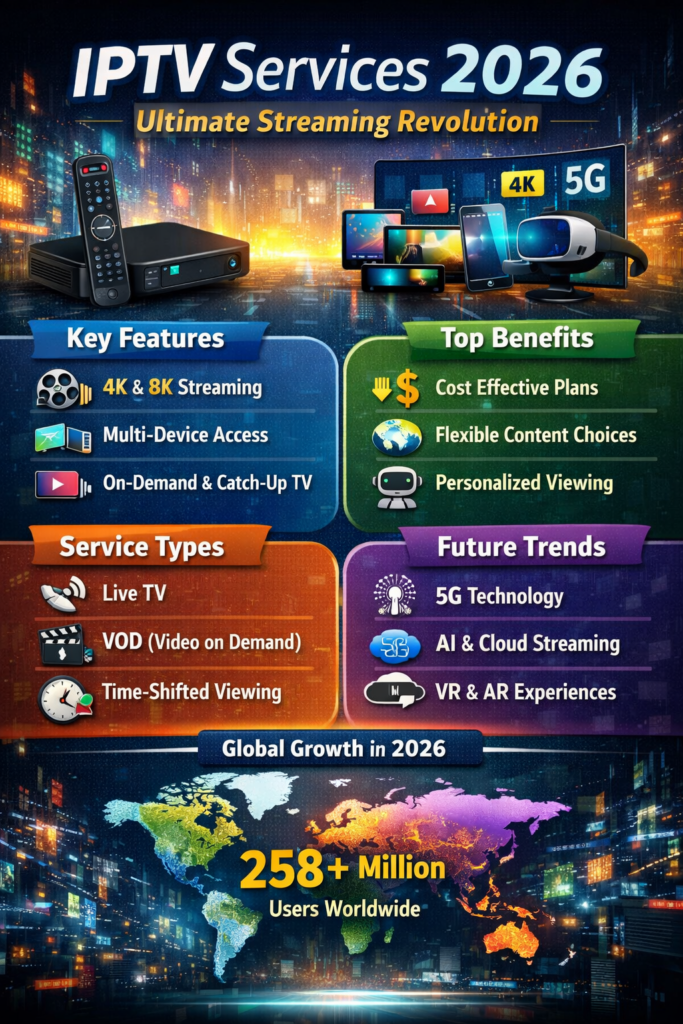
IPTV Services 2026 are transforming global entertainment with better quality, more content freedom, and innovative features driven by AI and 5G.
Streaming technology continues to evolve at a rapid pace, and IPTV Services 2026 are now recognized as the leading format for modern television consumption. In contrast to traditional cable or satellite broadcasting, IPTV leverages internet protocol networks to deliver live TV, Video-on-Demand (VOD), time-shifted content, and interactive media to millions of subscribers worldwide. As the industry enters 2026, a combination of new infrastructure, faster networks, improved codecs, smarter applications, and global market adoption are redefining how audiences watch their favorite content.
Understanding IPTV Services 2026
IPTV (Internet Protocol Television) refers to a delivery method where television content is streamed through broadband networks instead of broadcast signals. While IPTV has existed for more than two decades, the leap happening in 2026 is unprecedented in performance, accessibility, and global adoption. More households now consume television using IP-based systems than satellite dishes in several regions.
What Makes IPTV Different From Cable TV
Traditional cable TV uses coaxial infrastructure to transmit channels to customers. Cable is one-directional — providers push content downstream, and users merely receive it. IPTV flips that model. With IPTV:
- Users request streams on demand
- Servers send content directly over IP networks
- Interaction becomes personalized and dynamic
Additionally:
| Feature | Cable TV | IPTV |
|---|---|---|
| Transmission | Coaxial / Satellite | Internet Protocol |
| Interactivity | None | High |
| Content Type | Linear only | Live + VOD + PPV + Time-Shift |
| Device Support | TVs only | TVs, Phones, Tablets, PCs |
| Customization | Standard | Personalized |
| Scalability | Limited | Global |
This flexibility is one of the major reasons why IPTV Services 2026 are exploding in popularity.
How IPTV Delivers Content Over IP Networks
The underlying architecture has also matured. IPTV uses a combination of:
- Content delivery networks (CDNs)
- Edge servers
- Buffering and compression algorithms
- Adaptive bitrate streaming
- Real-time transport protocols (RTP/RTSP)
- Cloud-based transcoding
This infrastructure ensures that even live sports and events can be streamed in ultra-low latency with minimal jitter. With the rollout of fiber internet, Wi-Fi 7, and 5G standalone networks, the performance gap between IPTV and cable isn’t just closed — it’s reversed.
The Massive Growth of IPTV in 2026
The IPTV market is experiencing one of the fastest digital entertainment expansions in history. According to industry estimates, IPTV subscriptions are expected to surpass 258 million users globally in 2026, with significant compound annual growth rates across Asia, Europe, North America, and the MENA region. Several trends are driving this acceleration.
Global Market Trends & Adoption Stats
Growth has been fueled by:
- Affordability of IPTV subscriptions
- Increasing cord-cutting behavior
- Content globalization
- Improved network and fiber infrastructure
- Surge in VOD consumption
- Smart TV proliferation
In 2026, more than 82% of new TV shipments are smart TVs with native IPTV app support, making the onboarding experience frictionless. Meanwhile, telecom providers are bundling IPTV with fiber packages to increase retention.
Regions with the Fastest IPTV Growth
While IPTV is gaining traction worldwide, several regions are experiencing explosive growth:
- Middle East & North Africa: Driven by football broadcasting and Arabic IPTV platforms.
- Europe: Advanced fiber networks and regulatory backing.
- Asia-Pacific: Massive population and smartphone adoption.
- North America: Cord-cutting culture and premium VOD ecosystem.
Even developing markets are accelerating due to affordable Android IPTV boxes and subscription-sharing trends.
Key Features of IPTV Services 2026
The competitive landscape is forcing IPTV providers to offer more innovative features and better streaming experiences than ever before.
Video Quality Improvements (4K/8K/VR)
The visual leap from HD to 4K and beyond is now standard across premium IPTV plans. In addition, VR streaming for sports and concerts is gaining traction. Improved codecs like H.266/VVC and AV1 reduce bandwidth requirements by more than 40%, enabling smoother playback even on modest connections.
Multi-Device Streaming Capabilities
IPTV platforms support simultaneous streaming across:
- Smart TVs
- Laptops
- Mobile devices
- Tablets
- IPTV boxes
- Gaming consoles
Account systems and authentication ensure device limits and concurrency rules, but families enjoy far greater content freedom compared to cable.
On-Demand & Catch-Up TV Evolution
VOD libraries are expanding dramatically. Users can now:
- Watch missed episodes (catch-up TV)
- Rewind or pause live channels
- Request local program recordings
- Order PPV events instantly
The combination of VOD + live + replay creates a complete media ecosystem unmatched by cable broadcasting.
Top Benefits of IPTV Services in 2026
While IPTV adoption is skyrocketing, it’s the benefits that make IPTV Services 2026 so compelling for consumers and businesses alike. From affordability to personalization, IPTV is no longer seen as an alternative—it’s becoming the standard.
Cost Efficiency Compared to Cable
One of the most dominant advantages is cost. Traditional cable TV packages can be expensive due to broadcasting licenses, infrastructure fees, and regional monopolies. IPTV disrupts this model entirely.
With IPTV, users typically pay:
- Lower subscriptions
- Flexible monthly renewal options
- No hardware installation fees
- No signal dish or cabling requirements
- No mandatory long-term contracts
Instead of region-locked content bundles, IPTV platforms offer global channel access. This freedom drives competitive pricing and puts pressure on cable companies still relying on rigid pricing structures.
Content Flexibility & Freedom
Cable subscribers usually receive hundreds of channels they never watch. IPTV flips the paradigm by enabling:
- Selective channel category plans
- Specialty content bundles (sports, entertainment, education)
- Multilingual packages
- VOD-only plans
Moreover, IPTV plans are often location-agnostic, allowing travelers, expatriates, or international viewers to access desired content without physical borders.
Personalized User Experience with AI
One underrated innovation in IPTV Services 2026 is artificial intelligence. AI now analyzes:
- Watch history
- Device behavior
- Genre preferences
- Viewing schedules
- Language preferences
Based on this data, platforms recommend:
- Personalized shows
- Curated playlists
- Sports highlights
- Suggested VOD movies
- Trending channels
This personalization mimics platforms like YouTube and Netflix, but IPTV blends real-time live channels into the same intelligent ecosystem—something cable could never do.
IPTV Service Types Explained
The IPTV ecosystem features multiple content formats that make it more dynamic than cable. These include:
Live IPTV Streaming
This is the direct replacement for linear television. It includes:
- News channels
- Sports broadcasts
- Live events
- Music channels
- International channels
Live IPTV uses multicast or unicast delivery depending on infrastructure, optimizing for latency and viewer load.
VOD (Video on Demand) Services
VOD provides instant playback access to movies, series, and shows. Users can:
- Pause content
- Skip or fast-forward
- Resume later
- Browse categorized libraries
In IPTV Services 2026, VOD libraries are now rivaling global streaming platforms thanks to licensing partnerships and modular content packages.
IPTV Time-Shifted Media
Time-shifted IPTV allows viewers to watch missed programs hours or days after original broadcast. This feature is a game-changer for users in foreign time zones or with busy schedules.
Examples include:
- Replay TV
- Catch-up channels
- 24-hour rewinds
- Cloud DVR recordings
Key Challenges Facing IPTV Providers
As the market matures and competition intensifies, IPTV providers face several real-world challenges.
Network Congestion & Buffering Issues
While improved compression, CDNs, and 5G networks reduce latency, congestion problems still arise, especially during:
- Sports finals (e.g., Champions League, NFL, UFC)
- Pay-Per-View fights
- World Cup events
- Award shows
Providers solve this through:
- Edge caching
- Multi-server load balancing
- Adaptive bitrate streaming
Yet consumer frustration with buffering remains a competitive risk.
Digital Rights & Licensing Barriers
Content licensing is the backbone of legal IPTV. Providers must negotiate rights for:
- Channels
- Movies
- Sports leagues
- Regional broadcasts
The licensing landscape is expensive and fragmented. Many IPTV players struggle to scale legally due to these cost structures.
Content Security & Anti-Piracy Measures
Security concerns in IPTV often involve:
- DRM protection
- Secure streaming protocols
- Token authentication
- Anti-restreaming systems
New watermarking technologies in IPTV Services 2026 are helping broadcasters track illegal re-streamers more effectively.
IPTV Hardware & Software Ecosystem
The ecosystem powering IPTV Services 2026 is broader than most consumers realize. While content and apps sit at the forefront, the hardware and software layers behind them make IPTV possible at scale.
IPTV Boxes & Android TV Devices
A significant share of IPTV users rely on dedicated streaming devices. The most popular categories in 2026 include:
- Android TV boxes
- Amazon Fire TV devices
- Apple TV units
- Linux-based IPTV receivers
- MAG & Formuler boxes
- Custom IPTV set-top boxes
These devices decode streams, handle DRM restrictions, and support third-party or native IPTV applications. Android-based platforms dominate due to flexibility, affordability, and universal app compatibility.
Many IPTV boxes now support:
- 4K & 8K playback
- H.265 / H.266 codecs
- Dual-band Wi-Fi
- Ethernet ports for stability
- Bluetooth remote controls
- Voice search commands
The user experience is significantly better than traditional cable boxes, which were often limited in functionality and software capabilities.
Smart TV & Mobile App Platforms
Smart TVs are transforming the IPTV landscape even faster than set-top boxes. With 82% of new TVs shipping with app ecosystems, IPTV can run natively without external hardware.
Supported platforms include:
- Tizen (Samsung)
- webOS (LG)
- Android TV / Google TV
- Roku OS
- Fire OS
- Sony proprietary systems
On the mobile side, IPTV apps provide unmatched convenience. Users can stream through:
- Smartphones
- Tablets
- Laptops
- Gaming consoles
This multi-device compatibility allows users to carry live TV and VOD content anywhere, a feature cable TV simply couldn’t provide.
Choosing the Best IPTV Service in 2026
With hundreds of IPTV platforms emerging worldwide, selecting the right service requires structured comparison. To avoid consumer frustration, several key criteria should be evaluated.
Factors to Compare
When comparing IPTV Services 2026, users should look at:
- Channel Variety
Local + international + premium + niche categories. - Server Stability & Reliability
Less buffering = better experience. - Video Quality Options
SD, HD, FHD, 4K, and in some cases 8K. - EPG & Catch-Up Support
Electronic guides enhance navigation. - Device Compatibility
Works across TVs, mobiles, and boxes. - Customer Support & Uptime
24/7 assistance for worldwide subscribers. - Pricing & Contract Flexibility
Monthly vs. yearly vs. lifetime offers. - Trial Access
Free trials help validate stability.
Recommended IPTV Providers (2026 Snapshot)
While this article avoids endorsing illegal platforms, legal IPTV providers performing well in 2026 include:
- YouTube TV
- FuboTV
- Hulu + Live TV
- Sling TV
- Philo
- DirecTV Stream
Each serves different demographics. For example, FuboTV is sports-focused, while Philo targets entertainment at lower price points.
IPTV Pricing Models in 2026
The pricing landscape changed dramatically as IPTV shifted from niche streaming to mainstream consumption. Several monetization models coexist today.
Subscription-Based Models
This is the most common IPTV pricing approach. Consumers pay monthly or yearly for:
- Channel access
- VOD libraries
- Catch-up features
- Premium add-ons
Years of cable bundling have trained users to accept subscription-based streaming as natural and convenient.
Pay-Per-View (PPV) Models
PPV remains popular in sports and entertainment, particularly for:
- MMA events
- Boxing fights
- Wrestling
- Concerts
- Award ceremonies
PPV coexists alongside subscriptions to maximize revenue and licensing value.
Hybrid Monetization Strategies
In IPTV Services 2026, hybrid models are emerging where providers mix:
- Base subscription tier
- Premium sports add-ons
- PPV events
- Cloud DVR subscriptions
- Ad-supported tiers
Streaming platforms are now experimenting with ad-tiered pricing to reduce plan costs and attract price-sensitive users.
IPTV vs Streaming Services vs Cable
With so many content delivery technologies coexisting, consumers often wonder which offers the best value. Here’s a simplified comparison:
| Category | IPTV | Cable TV | Streaming Services |
|---|---|---|---|
| Delivery | Internet Protocol | Coaxial / Satellite | Cloud Servers |
| Content Type | Live + VOD + Time-Shift | Live Only | VOD Only |
| Cost | Low–Medium | Medium–High | Low–Medium |
| Device Support | Multi-device | TV only | Multi-device |
| Contract | Flexible | Long-term | Flexible |
| Global Access | Yes | No | Yes |
| Personalization | High | Low | High |
Future of IPTV Beyond 2026
The most exciting element of IPTV Services 2026 isn’t merely what the technology is today, but where it’s headed. Future IPTV ecosystems will be deeply influenced by cloud streaming, artificial intelligence, immersive interfaces, and ultra-low latency networks.
AI, 5G & Cloud Streaming Influence
Several transformative technologies will define IPTV’s next decade:
1. Artificial Intelligence Personalization
AI will refine:
- Viewing recommendations
- Channel navigation
- Ad personalization
- Automatic highlight generation
- Content discovery
Future IPTV platforms may behave like digital assistants, not just video players.
2. 5G Standalone Networks
With 5G SA deployments accelerating worldwide, IPTV streams will benefit from:
- Lower latency
- Higher stability
- Massive bandwidth
- Edge computing integration
This unlocks features such as instant 8K sports streaming and real-time betting overlays for live matches.
3. Cloud-Based IPTV
Instead of local hardware decoding, cloud IPTV allows rendering and transcoding to be done remotely, reducing device dependency and extending hardware lifespan.
4. Immersive Content Experiences
VR and AR layers are already being tested for:
- Concerts
- Stadium broadcasts
- Newsrooms
- Educational content
Consumers may soon “sit” courtside at NBA games or stand inside music festivals using IPTV-enabled VR streams.
5. Dynamic Licensing & Global Content Mobility
Regulatory and licensing models will evolve, enabling users to legally access international channels without geo-barriers. Cloud-based licensing marketplaces are already emerging to make global content more accessible.
FAQs — IPTV Services 2026
Below are commonly asked questions to help clarify key details.
1. Is IPTV legal in 2026?
Yes, IPTV itself is legal. Legality depends on whether providers have the correct broadcasting rights for the channels and content they distribute.
2. Does IPTV require fast internet?
Most IPTV Services 2026 providers recommend:
- 10 Mbps for HD
- 25 Mbps for 4K
- 50 Mbps+ for multi-device streaming
Higher speeds reduce buffering and enhance quality.
3. Can IPTV replace cable TV fully?
For many households, IPTV already has. IPTV offers broader content flexibility, better pricing, device compatibility, and on-demand access.
4. What devices support IPTV in 2026?
Compatible devices include:
- Smart TVs
- Android TV boxes
- Smartphones
- Laptops
- Tablets
- Fire TV devices
5. Is IPTV good for sports?
Absolutely. Sports streaming is one of IPTV’s strongest use cases due to:
- HD/4K feeds
- Live replays
- Multi-language commentary
- PPV event support
6. Do IPTV providers offer VOD libraries?
Yes. VOD libraries have expanded exponentially and often include:
- Movies
- Series
- Documentaries
- Kids content
- International catalogues
Some are even larger than traditional streaming service libraries.
Conclusion
The television landscape has undergone a massive transformation, and IPTV Services 2026 stand at the center of that evolution. Consumers are no longer limited by cable companies, geographical content licensing blocks, or rigid broadcasting schedules. IPTV introduces a future where content is personalized, device-agnostic, globally accessible, competitively priced, and enhanced by cloud and AI-driven technology.
As adoption grows and infrastructure modernizes, IPTV is poised not only to replace traditional cable TV but to redefine how the world consumes entertainment. In the years ahead, innovations such as VR sports arenas, AI channel assistants, immersive concerts, and cloud-rendered playback could reshape IPTV into a fully interactive media ecosystem.
For additional industry insight, readers can explore research from reputable organizations such as the European Broadcasting Union (EBU).