
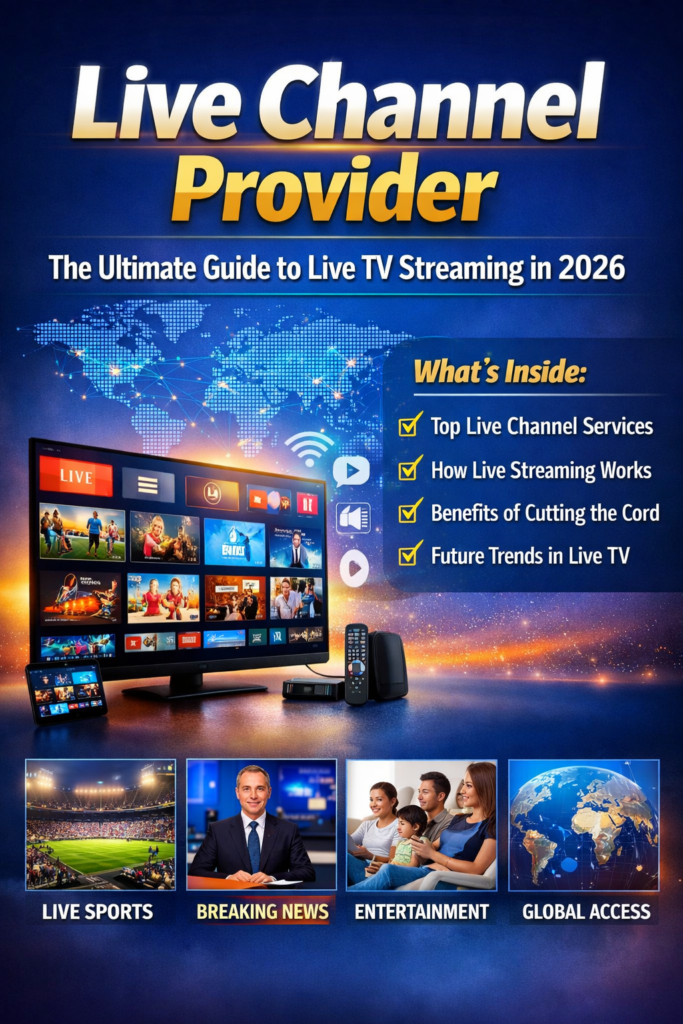
Looking for a reliable live channel provider? Discover top features, smooth streaming, and flexible plans that fit your needs today.
Live Channel Provider is a term more people are hearing today as streaming services overtake traditional TV and redefine how we watch content. Whether it’s global sports, breaking news, or your favorite shows — live channels are moving far beyond cable boxes and satellite dishes. But what exactly is a live channel provider, why is it becoming so essential, and how can you choose the right one in an ever-changing digital world? Let’s dive in.
Article Outline (20 Headings/Subheadings)
- Understanding Live Channel Providers
- What Exactly Is a Live Channel?
- Evolution of Television: From Cable to Internet
- How Live Channel Providers Work
- The Technology Behind Streaming Live Channels
- Over-the-Top (OTT) Services Explained
- Popular Live Channel Providers in 2026
- 7.1 Hulu + Live TV
- 7.2 YouTube TV
- 7.3 Philo
- 7.4 Frndly TV
- 7.5 Regional and International Providers
- IPTV vs Traditional Providers
- Legal Licensed vs Unlicensed Providers
- Benefits of Using Live Channel Providers
- Live Sports and Events Streaming
- News and Real-Time Coverage
- Family and Entertainment Live Channels
- Pricing Models and Subscription Plans
- Must-Have Features in 2026
- Challenges in Live Streaming Delivery
- Future of Live Channel Providers
- How to Choose the Right Provider for You
- Growing Trends in Live TV Consumption
- Conclusion & FAQs
Understanding Live Channel Providers
As streaming continues to explode worldwide, more people are ditching traditional cable for services that let them watch live TV over the internet. A live channel provider is simply a company or platform that delivers those live broadcasts — whether sports, news, entertainment, or events — directly to your device through streaming technology. These services don’t require satellite dishes or set-top boxes, just a decent internet connection and a compatible device like a smart TV, phone, or streaming stick.
This shift isn’t accidental — viewers today want flexibility, instant access, and the ability to watch anywhere, anytime. Older TV transmission methods like terrestrial or cable are being overshadowed by this new era of internet-enabled viewing. And with nearly half of global TV consumption now coming from streaming platforms, live channels are no longer a niche — they’re a staple.
What Exactly Is a Live Channel?
A live channel broadcasts content as it happens in real-time. Unlike on-demand shows that you watch when you choose, live channels follow a scheduled programming lineup — just like traditional TV. This makes them perfect for:
- Breaking news and current events
- Live sports and sports talk shows
- Premieres of television shows
- Awards, concerts, and cultural events
Think of it as watching TV the way you always have — but a lot smarter and more flexible. You don’t have to be at home, you don’t need a cable box, and you can often pause or rewind shows if your provider supports that feature.
Evolution of Television: From Cable to Internet
In the early 2000s, cable and satellite services dominated the airwaves. But as broadband internet became faster and more affordable, a dramatic shift began. Viewers started demanding more control — skipping commercials, choosing where to watch, and ditching fixed contracts.
Enter Live Channel Providers — streaming platforms that combine the best of both worlds: modern internet flexibility and traditional broadcast schedules. It’s the evolution of TV. No one needed to tell anyone that Netflix blocked the old cable route; consumers simply moved where the content went. And in doing so, they changed what “watching TV” actually means.
This transformation continues year after year, and by 2025, streaming accounted for a larger share of TV viewing than even cable did.
How Live Channel Providers Work
Live channel providers use internet technology — most often known as over-the-top (OTT) delivery — to bring broadcast channels straight into apps and services. Unlike traditional cable or satellite, with OTT, content is streamed through IP networks (which is just the internet) to your device.
Platforms license channel feeds from content owners, encode them, and deliver them in real-time through a mix of data centers and content delivery networks (CDNs). When you press play, your device requests the stream, and the provider sends it over the internet at a speed suited to your connection.
That’s why a strong broadband connection is essential — no matter how great your provider is, if your network can’t support it, the experience will lag or buffer.
The Technology Behind Streaming Live Channels
Streaming live channels isn’t magic — it’s advanced infrastructure working behind the scenes. Here’s a breakdown of what makes it work:
- Adaptive Bitrate Streaming: Automatically adjusts video quality based on your internet speed.
- Content Delivery Networks (CDNs): Distributes content through servers worldwide for fast delivery.
- Real-Time Encoding: Converts broadcast signals into data packets quickly so you see what’s happening live.
- Cloud DVR: Allows you to pause and record live shows to watch later.
Advances like edge computing and low-latency transmission are also improving how live content gets from the studio to your screen faster and smoother than ever.
Over-the-Top (OTT) Services Explained
When you hear OTT, think of services that bypass traditional TV infrastructure and go straight to the consumer via the internet. OTT services include both on-demand platforms like Netflix and live channel providers that stream scheduled broadcasts online.
These services have become a majority of TV viewing across many countries, especially where mobile and high-speed internet access thrive. For example, global streaming platforms saw growth that surpassed traditional networks in both subscriptions and viewing time by 2025.
Popular Live Channel Providers in 2026
Today’s market is crowded — but here are some of the standout live channel services that many viewers rely on:
Hulu + Live TV
Hulu + Live TV combines on-demand content with 75+ live channels — from news and sports to entertainment — all in one place.
YouTube TV
Offering 100+ channels, unlimited DVR, and strong local network coverage, YouTube TV is a reliable choice for many households.
Philo
Best for budget-minded viewers, Philo provides dozens of entertainment channels at lower prices — though sports options are limited.
Frndly TV
Focused on family-friendly programming, Frndly TV brings a curated set of live channels without heavy sports or news emphasis.
Regional and International Providers
In markets outside the U.S., services like JioTV in India continue to offer extensive live TV portfolios — sometimes numbering over 1,000 channels.
IPTV vs Traditional Providers
Internet Protocol Television (IPTV) refers to any TV delivered via internet protocols instead of cable or satellite. Many live channel providers are built on IPTV technology — enabling viewers to stream TV much like they would watch YouTube or Netflix.
The key difference? Instead of downloading a show, IPTV delivers channels live in real-time — with scheduled content just like traditional TV but far more flexible and accessible.
Legal Licensed vs Unlicensed Providers
Not all live channel providers are created equal. Legal, licensed services pay for the rights to stream channels, ensuring reliable access and quality. Unlicensed services, often found in online forums, may claim huge channel lists — but they operate in a legal gray area and can put your devices or data at risk.
Always choose providers that operate transparently and respect copyright laws.
Benefits of Using Live Channel Providers
Live streaming providers bring enormous benefits:
- Flexibility: Watch on multiple devices.
- No Long Contracts: Many plans are month-to-month.
- Feature Rich: Cloud DVR, multi-screen support, and personalization.
- Cost-Effective: Often cheaper than cable.
Plus, innovation keeps improving things — from bundled sports packages to smarter recommendations.
Live Sports and Events Streaming
Sports fans, rejoice: streaming has revolutionized how we watch games. Providers increasingly bundle live sports networks and offer interactive features like real-time stats and multiple camera angles. Some services, like ESPN Unlimited, now offer entire portfolio access for streaming audiences.
News and Real-Time Coverage
Breaking news — live and unfiltered — is a major draw for live channel services. Whether it’s global headlines or local updates, these providers deliver reliable coverage in real-time without cable restrictions.
Family and Entertainment Live Channels
Channels dedicated to family programming, lifestyle, and entertainment — like those offered on Philo and Frndly TV — fill up evenings and weekends, giving viewers diverse content to enjoy as it airs.
Pricing Models and Subscription Plans
Live channel providers vary widely in price. Some offer budget tiers with core channels, while others bundle premium networks or features like sports add-ons and unlimited DVR. Expect monthly charges anywhere from small bundles to premium, all depending on how extensive the lineup is.
Must-Have Features in 2026
When choosing a provider, look for:
- Unlimited DVR options
- Multi-device support
- Strong mobile apps
- User profiles
- Reliable streaming quality
The best providers keep innovating to meet viewer expectations.
Challenges in Live Streaming Delivery
Despite advances, challenges remain — buffering during peak times, latency, and regional restrictions still impact viewers. Providers continue working on technology upgrades to reduce lag and improve quality.
Future of Live Channel Providers
The future is bright: expect more personalized channels, advanced content discovery, and deeper integration with smart home and AI tools.
Some services are even blending traditional broadcast models with streaming to offer hybrid experiences.
How to Choose the Right Provider for You
Ask yourself:
- What channels matter most?
- Do you need sports?
- How important is price?
- Do you want cloud DVR?
Matching these answers with available services usually leads to satisfaction.
Growing Trends in Live TV Consumption
Live TV streaming isn’t static. Viewership continues to grow, mobile consumption rises, and traditional cable continues to decline across markets. This means more choice — and smarter TV for everyone.
Conclusion
Live channel providers are the backbone of modern television viewing. They bring real-time broadcasts to your devices with flexibility, choice, and often better value than traditional cable. Whether it’s global sports, news, or entertainment, the right provider can transform how you watch TV — without locking you into outdated technology.
FAQs
1. What’s the difference between a live channel provider and cable TV?
A live channel provider streams live broadcasts over the internet without satellite dishes or set-top boxes, while cable relies on traditional physical infrastructure.
2. Can I watch live channels on my phone?
Yes! Most streaming live channel services have mobile apps.
3. Do I need fast internet to stream live TV?
Yes, a stable broadband connection is essential for smooth live streaming.
4. Are live channel providers legal?
Licensed providers are; always choose services that pay for content rights.
5. Can I record live TV with these services?
Many offer cloud DVR, letting you record shows to watch later.